America’s Islamic Heritage Museum in DC
Visitors only need a few minutes in DC’s newest museum to realize that their U.S. history has been a few pixels short of the full picture.
“This is a story we don’t know yet,” says D. Paul Monteiro, religious liaison for the White House. “African American Muslims were part of this country’s story before there was a country….and this story needs to be told.”…
Appeared in Hill Rag and East of the River, Capitol Community News, September 2011, as “DC’s Newest Museum: A Fuller Picture of American Muslims.” Full text, as it originally appeared, follows downloadable PDF.
UPDATE: Please note that America’s Islamic Heritage Museum website is now available via Archive, and updates can be found through Facebook. The museum is no longer on MLK Avenue, SE, due to redevelopment of the area.
PDF version from September 2011 East of the River —
Full text as it originally appeared:
“DC’s Newest Museum: A Fuller Picture of American Muslims” by Virginia Avniel Spatz. September 2011 Hill Rag AND East of the River
Visitors only need a few minutes in DC’s newest museum to realize that their U.S. history has been a few pixels short of the full picture.
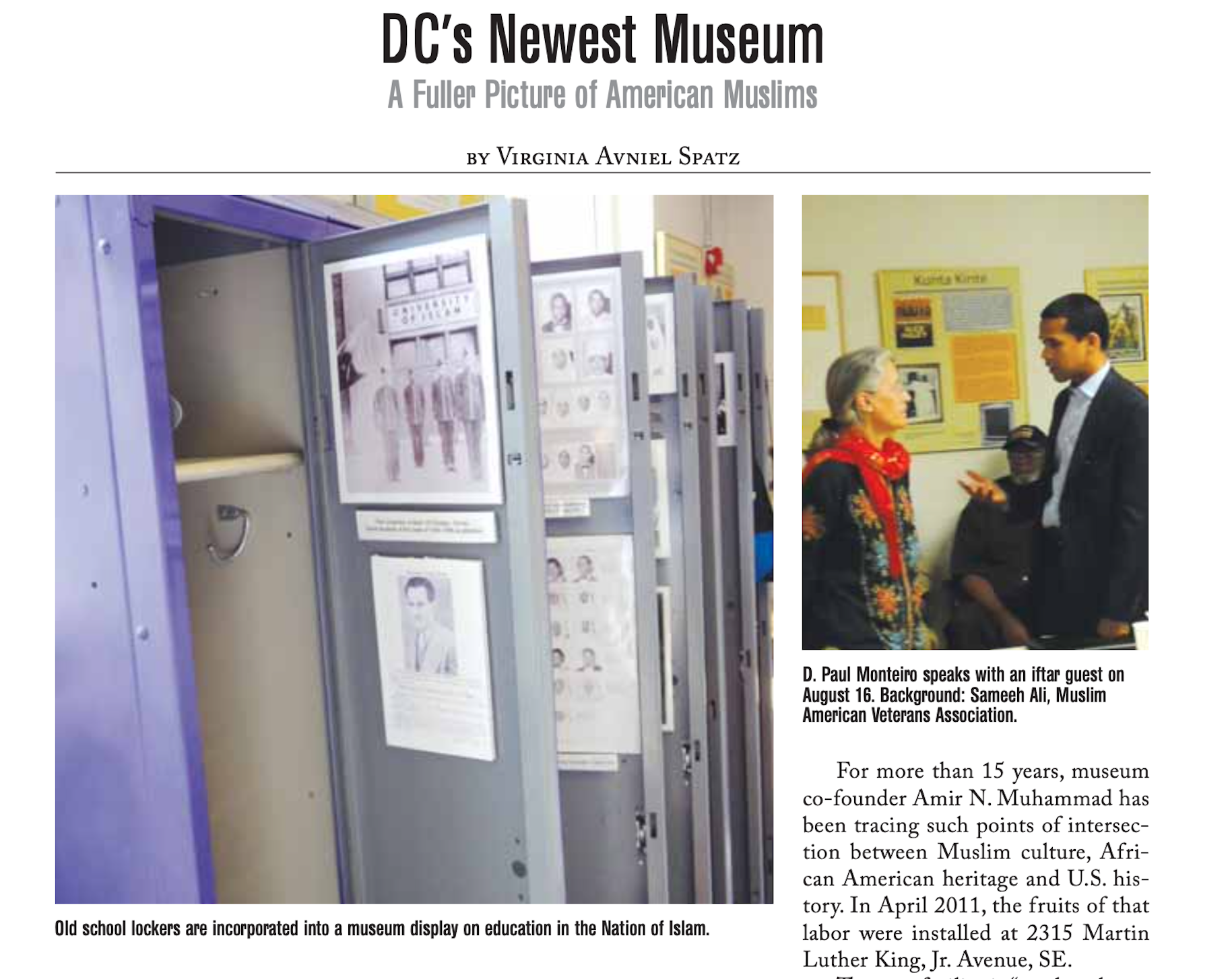
“This is a story we don’t know yet,” says D. Paul Monteiro, religious liaison for the White House. “African American Muslims were part of this country’s story before there was a country….and this story needs to be told.”
America’s Islamic Heritage Museum and Cultural Center fills in pieces of U.S. history missing from most people’s view. On exhibit, for example, is a copy of the 1733 portrait of Ayuba Suleiman Diallo (aka Job ben Solomon), a West African Muslim enslaved for a time in Maryland. The story of Diallo (“d’jallo”) was published in England in 1734, and his portrait was painted by William Hoare of Bath. Nearby is an Arabic booklet dated 1829. The short review of Muslim jurisprudence was written out by Bilali (Ben Ali) Muhammad, enslaved on Sapelo Island, Georgia.
For more than 15 years, museum co-founder Amir N. Muhammad has been tracing such points of intersection between Muslim culture, African American heritage and U.S. history. In April 2011, the fruits of that labor were installed at 2315 Martin Luther King, Jr. Avenue, SE.
The new facility is “a cultural gem for the neighborhood,” declares Patsy Fletcher, of the DC Historic Preservation Office.
“The Full Story”
Muhammad, with his wife Habeebah, crafted traveling exhibits for display at mosques, churches, universities and libraries. In cooperation with the U.S. State Department, the exhibits were shared with visitors from around the world and traveled to Nigeria and Qatar. The collection has reached some 60,000 people and is now settled at the former Clara Muhammad School.
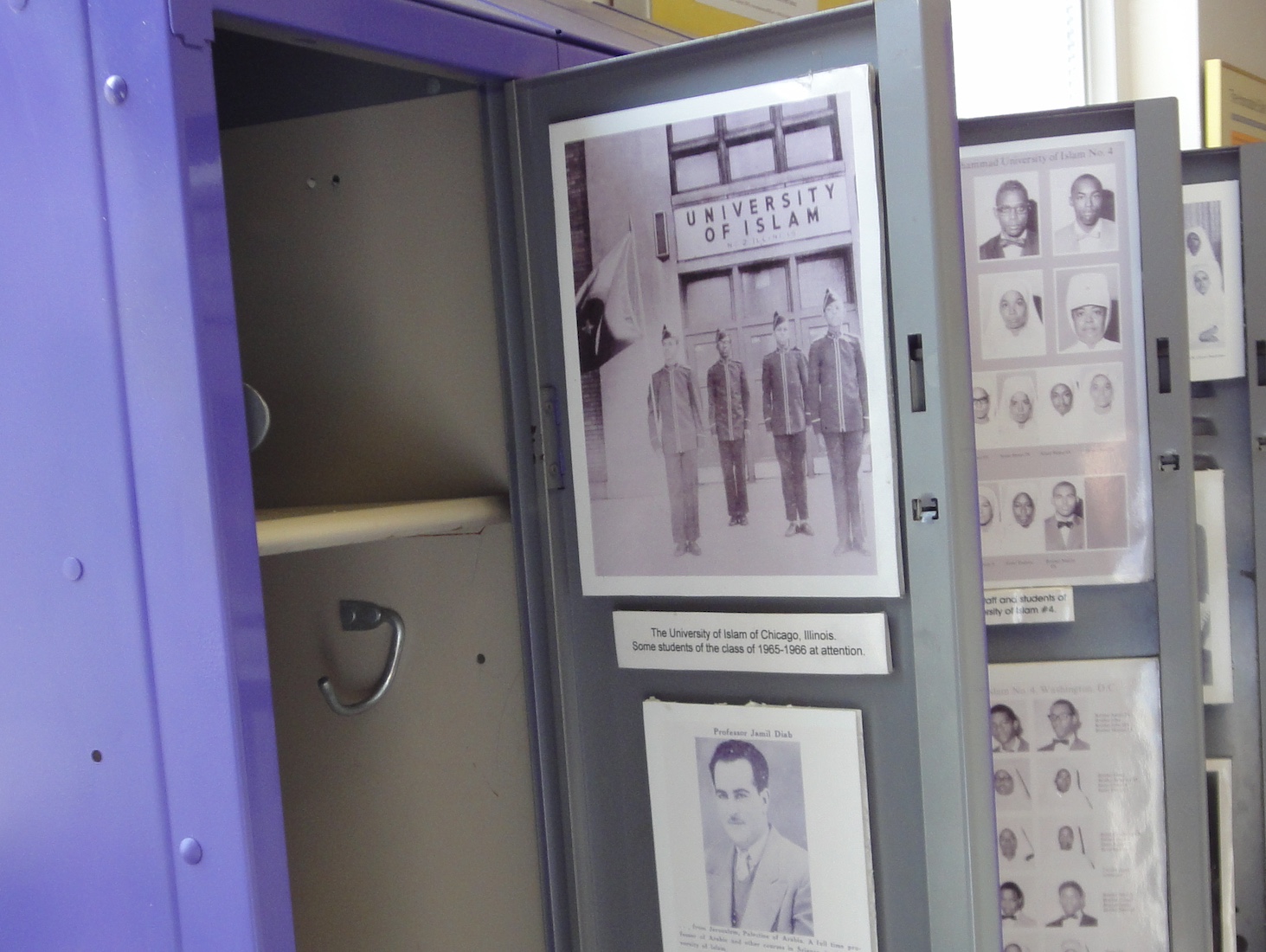
Displays trace a history that extends from pre-Columbian Muslim explorers to contemporary Muslims praying at the White House. An 1853 translation of the Qur’an saved from a Civil War fire is presented in one room. Another offers vinyl recordings of Elijah Muhammad and other artifacts from the Nation of Islam. Woven throughout are census records, photos of mosques built over the decades and artifacts from centuries of Muslim history in the U.S. and African American culture.
Incorporating the Nation’s story, including the conversion of many to Sunni Islam, helps tell the story of Masjid Mohammed, DC’s 50-year-old predominantly African American mosque. It also places the Nation squarely withing the larger Muslim narrative. For some time, Muhammad explains, “the immigrant Muslim community didn’t want to own our story.”
“Some academics view the Nation as aberrant,” Dr. Aminah McCloud, director of Islamic World Studies at DePaul University in Chicago, adds. “But the history of Islam in America is long…On the other side of it, if people see African American Islam only as emerging from the Nation, that is a distortion also.”
More generally, Muhammad says, the museum allows people of all backgrounds, Muslim and non-Muslim, to explore “how Muslims have been part of American life.”
McCloud, a museum advisor, hopes people will see a wide view of Muslims in the U.S. – “The Founding Fathers’ interaction with Muslims is extensive,” for example – and the context of African American history. “People should visit this museum. They should hear the full history.”
“The Muhammads’ efforts are extraordinary,” McCloud concludes. “They didn’t have access to grants and fellowships. They have done all of this on their own. And they’ve done well.”
Controversy and Opportunity
“There has been a lot of misunderstanding and misinformation,” particularly in the period surrounding the tenth anniversary of September 11, with pundits “competing against one another to smear the Muslim community,” Monteiro told a crowd gathered at the museum last month. “If the President could just make a speech to change the misperceptions, he would. But there is no substitute for the long, slow work of education.”
The “long overdue” museum helps in this endeavor, says Saudia Jenkins, Masjid Mohammed member and student (1990-2000) of the Clara Muhammad school. A positive element in all the conflict is “an opportunity to teach – I’ve been able to clarify what is and isn’t Islam…I hope the museum expands, so that people can see more contributions of Muslims.
Sameeh Ali, National Commander in Chief of the Muslim American Veterans Association, visiting from New Jersey, said his organization will be part of the expansion, donating memorabilia.
Monteiro and Ali were among guests at an August 16 iftar, a break-the-fast celebration held at sundown during the month of Ramadan. Another iftar, sponsored by the Embassy of Qatar, brought visitors from around the world to the museum.
“People are coming to the ‘hood’ for this,” Muhammad grins.
America’s Islamic Heritage Museum and Cultural Center, 2315 Martin Luther King Jr. Avenue, SE. (Green Line: Anacostia). 202-678-6906. Tues-Sat, 10-5 and Sun 11-5. Admission: $7 (students/seniors: $5; children: $3; group rates). http://www.MuslimsInAmerica.org
 Virginia Avniel Spatz