Previously Unreleased Correspondence Donated to Local Museum
“Ice cream” is not usually the first image associated with the name “Malcolm X.” But ice cream is just what Dr. Azizah al-Hibri thinks of when recalling her meeting and correspondence with “Brother Malcolm,” she recently told a crowd at Masjid Muhammad.
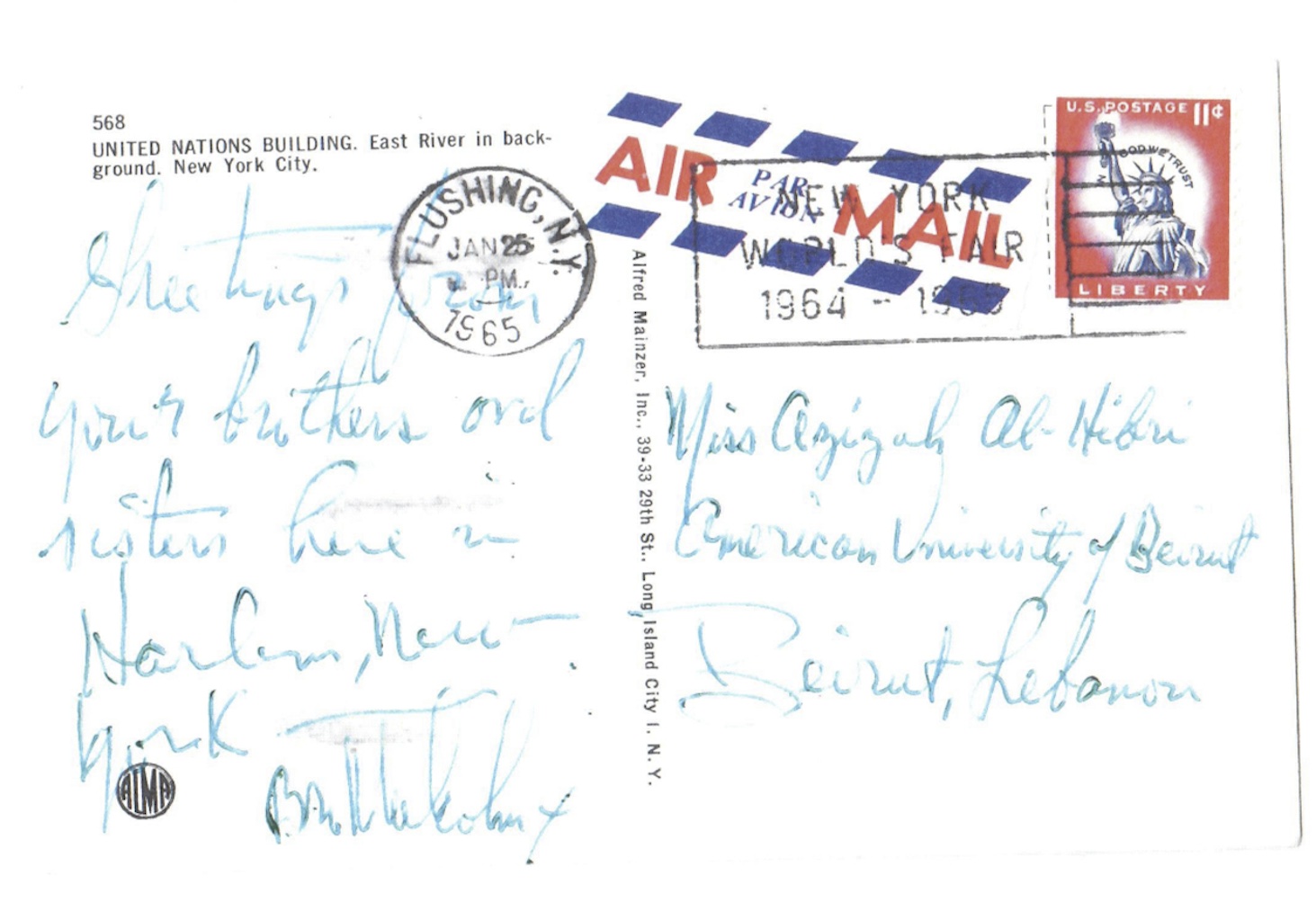
Al-Hibri, founder and chair of KARAMAH: Muslim Women Lawyers for Human Rights, just released some of her decades-old correspondence with El-Hajj Malik El-Shabazz, or Malcolm X. Some material, including his fond recollections of ice cream shared at the Beirut airport in 1964, was read to participants in a June 10 event at the mosque, 1519 4th St NW. Some will be made available to Masjid Muhammad, to Schomburg Center in Harlem (NYC), and to America’s Islamic Heritage Museum in Anacostia. Some will be kept private for the remainder of al-Hibri’s lifetime….
Originally appeared in East of the River, Capitol Community News, July 2012
Full text, as it originally appeared, follows downloadable PDF.
ORGANIZATIONAL UPDATE: Please note that Karamah: Muslim Women Lawyers for Human Rights is still available at the same website and phone number, but America’s Islamic Heritage Museum is now available via Archive or through Facebook and is no longer on MLK Avenue, SE, due to redevelopment of the area.
Post of related interest on SongEveryDay
PDF version from July 2012 East of the River —
Full text, as it originally appeared:
“New Words from Malcolm X: Previously Unreleased Correspondence Donated to Local Museum” by Virginia Avniel Spatz. July 2012 East of the River
“Ice cream” is not usually the first image associated with the name “Malcolm X.” But ice cream is just what Dr. Azizah al-Hibri thinks of when recalling her meeting and correspondence with “Brother Malcolm,” she recently told a crowd at Masjid Muhammad.
Al-Hibri, founder and chair of KARAMAH: Muslim Women Lawyers for Human Rights, just released some of her decades-old correspondence with El-Hajj Malik El-Shabazz, or Malcolm X. Some material, including his fond recollections of ice cream shared at the Beirut airport in 1964, was read to participants in a June 10 event at the mosque, 1519 4th St NW. Some will be made available to Masjid Muhammad, to Schomburg Center in Harlem (NYC), and to America’s Islamic Heritage Museum in Anacostia. Some will be kept private for the remainder of al-Hibri’s lifetime.
“We are delighted this is happening here,” said Albert Sabir, Masjid Muhammad executive assistant, at the June 10 event. “This is the nation’s masjid, or mosque, if you prefer. And this is historic.”
Amir Muhammad, who directs the AIH Museum, said the documents will be an important addition to the collection. He added that DC has its own connections with Malcolm X, noting in particular the six months he spent teaching in the District.
“This is historic for me, too” al-Hibri said on June 10, noting that she had kept the correspondence private for more than 40 years, at Malcolm’s request. She recently decided to release part of it, she says, to help ensure that Muslims are “proud” and “happy” about connections with the slain leader and to forge bonds between the African American Muslim community, with historical connections to the Nation of Islam, and what many call the “immigrant” Muslim community, with different historical roots.
Fiery Speech and Ice Cream
In the spring of 1964, Malcolm X traveled through the Middle East and Africa. One stop was Lebanon, where al-Hibri was then a student at the American University of Beirut. As president of the debating society, she arranged for Malcolm X to speak on campus.
Al-Hibri had only recently learned of the African American leader, she explains, when the European American Rev. Malcolm Boyd, an earlier speaker at her college, joked about being known in the U.S. Civil Rights movement as “Malcolm Y.” Knowing little about Malcolm X, she was surprised when administrators objected that he was “airing U.S. dirty laundry abroad” and denied permission for the speech. Urged by American students to stress “freedom of speech” in re-approaching the dean, however, she was able to overcome resistance.
Thinking strategically, al-Hibri had flyers printed and ready to distribute. When permission – which came only an hour before noon, the only time Malcolm could speak on his short stopover in Lebanon – was granted, the debating society was prepared. The speaker arrived to a standing-room only crowd and gave what she calls a “fiery, visionary” speech. Afterward, al-Hibri and the guest speaker lunched at the U.S. Embassy cafeteria, enjoying a far-reaching conversation. (A tape of the speech disappeared while they were eating, short-changing history as well as the debating society archives.)
Malcolm’s half-day in Lebanon was coming to a close, so al-Hibri accompanied him to the airport. There, he realized he had a Lebanese coins remaining in his pocket and offered them to her, saying he couldn’t possibly use them. But women in her culture didn’t accept money, even a few coins, from a man, she explains. So, he used the coins to buy ice cream and the two continued their conversation. And it was that ice cream that sparked a correspondence which continued until Malcolm’s death in February 1965.
Fame’s Prison and Global Vision
“I was a kid in his eyes,” al-Hibri says of her meeting with Malcolm X. “He was a grown man, a seasoned statesman and Civil Rights leader. I was a college student.” Moreover, she had little knowledge of U.S. racial politics and few pre-conceived ideas about the speaker she was hosting. Later, she had a hard time reconciling the media’s portrait with the handsome, friendly, intelligent man she’d met. But on that day in Lebanon, al-Hibri offered a rare opportunity for Malcolm: a chance to connect on a human and intellectual level, not a political one.
“The fame we get from fighting for the freedom of others creates a prison for us,” Malcolm wrote to al-Hibri after their meeting. From his correspondence it is clear that he already suspected that his life and work were coming to an end. But he knew, even though al-Hibri didn’t yet, that her future as a leader was ahead of her.
It was unusual in 1964, for a woman to be president of an organization like the college debating society, al-Hibri notes. And she, like many women of that decade, had not yet envisioned for herself anything like her role today as professor of U.S. law and international human rights advocate. It was similarly odd to consider that women might be leaders of Islam. But Malcolm X saw beyond the confines of his time, says al-Hibri, pointing to the words of encouragement he included in a book inscription: “You have and are everything it takes to create a new world – leadership is needed among women as well as among men…”
In their brief time together and in subsequent correspondence, Malcolm X shared his vision for a global community and his ideas about the role of media in changing perspectives. Today, nearly 50 years after his assassination, Muslims and non-Muslims are still working to realize some of that vision.
Contemporary Hurdles
“Islam does not condone racism,” al-Hibri said in response to an audience comment on June 10. Any evidence to the contrary, she continues, “is testament to the weakness of religious understanding or the strength of cultural racism in many places around the world.”
As in other religious and cultural groups in the U.S., there has been some fragmentation of different Muslim communities: recent immigrants, more assimilated American Muslims of foreign descent, and African American Muslims. The usual issues of language and custom have played a role. The Muslim community has been also fragmented by anti-terrorism laws, especially the “material support” provision. These laws, al-Hibri explains, have had a chilling effect on Muslims who became hesitant to contact Muslim institutions or donate to Muslim charities, at home or abroad.
Al-Hibri’s correspondence with “Brother Malcolm” bridged worlds in 1964, and she hopes donating it today will help build more bridges across Muslim communities and beyond.
KARAMAH: 202-234-7302, karamah@karamah.org. America’s Islamic Heritage Museum: 2315 Martin Luther King Ave SE, http://www.muslimsinamerica.org/
 Virginia Avniel Spatz