In 2015, a group of Muslims began meeting together, in different locations around DC. The story below reports on gatherings held at America’s Islamic Heritage Museum in Southeast DC. Eventually, the organization now known as Center DC found a stable home in Northwest DC. Its mission is to “help people practicing and exploring Islam grow closer to God, one relationship at a time,” according to their website, and Center DC continues to welcome all.
City Sundays and America’s Islamic Heritage Museum
I visited America’s Islamic Heritage Museum on October 11 and October 25 [2015], for the second in a series exploring worship communities east of the river from the perspective of a participant-observer, a roving Jew in the pew….
America’s Islamic Heritage Museum, in Historic Anacostia, shares the history of Muslims in America and promotes cross-cultural understanding around Islam. City Sundays, a new series of gatherings around town, is based in Islam but “open to all ethnicities, genders and faith traditions.” The two entities are fostering a diverse, new worship community….
Appeared in East of the River, Capitol Community News, November 2015, as “Learn. Build Community. Hang Out. City Sundays and America’s Islamic Heritage Museum.” Full text, as it originally appeared, follows downloadable PDF.
ORGANIZATIONAL UPDATE: Please note that America’s Islamic Heritage Museum website is now available via Archive, and updates can be found through Facebook. The museum is no longer on MLK Avenue, SE, due to redevelopment of the area.
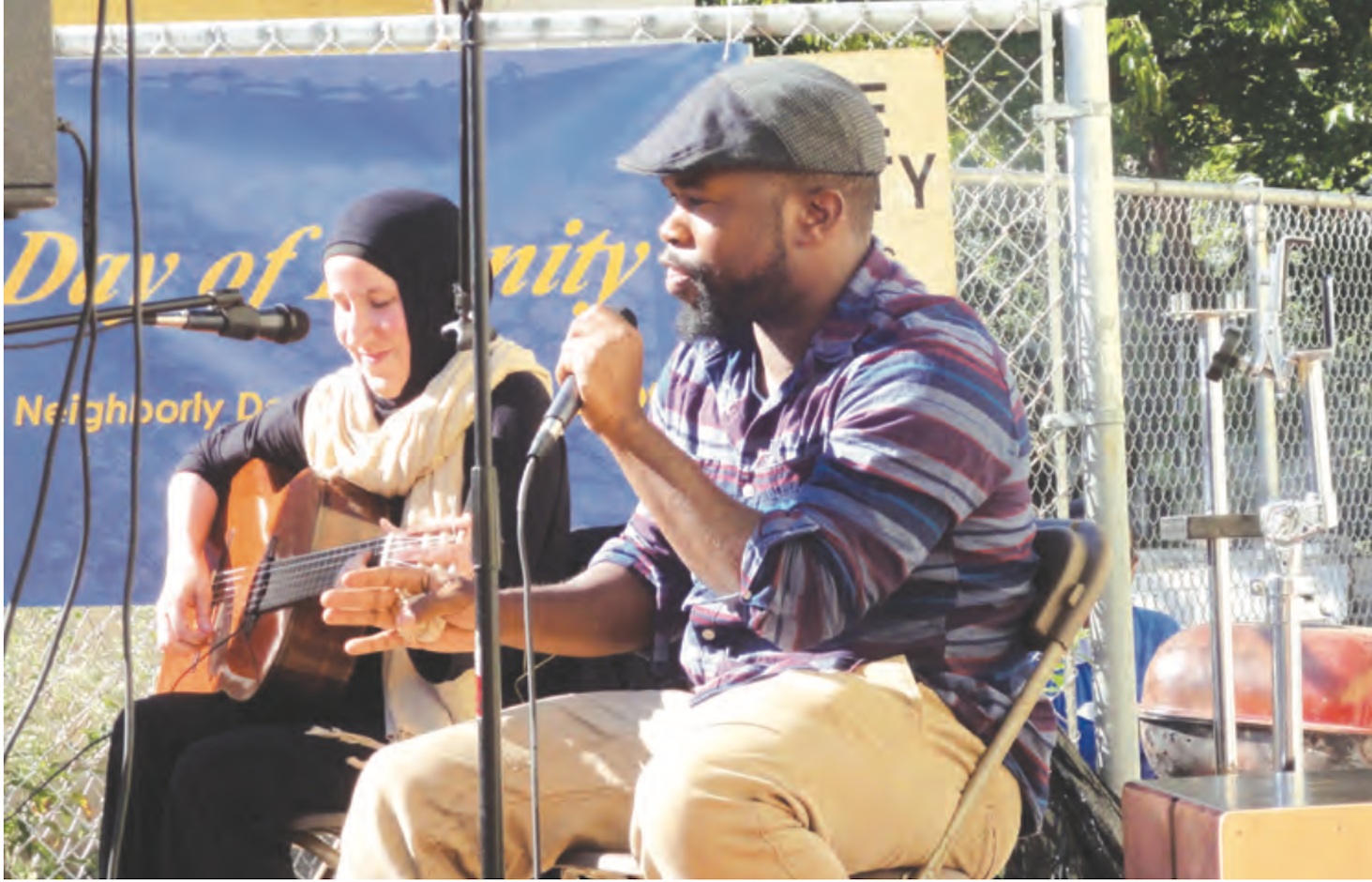
Lauren Schreiber, on guitar, and Muhammad Y. Oda, at the mic, perform together outside AIHM, then at 2315 Martin Luther King Jr Ave, SE, Oct 11, 2015.
PDF version from November 2015 East of the River —
Full text as it originally appeared:
“Learn. Build Community. Hang Out. City Sundays and America’s Islamic Heritage Museum” by Virginia Avniel Spatz in East of the River, November 2015
I visited America’s Islamic Heritage Museum on October 11 and October 25 [2015], for the second in a series exploring worship communities east of the river from the perspective of a participant-observer, a roving Jew in the pew….
America’s Islamic Heritage Museum, in Historic Anacostia, shares the history of Muslims in America and promotes cross-cultural understanding around Islam. City Sundays, a new series of gatherings around town, is based in Islam but “open to all ethnicities, genders and faith traditions.” The two entities are fostering a diverse, new worship community.
History and Mission
America’s Islamic Heritage Museum (AIHM) is a project of the Ward 8-based non-profit, Collections & Stories of American Muslims, established by Amir Muhammad in 1996. Since 2011, AIHM has occupied the former Clara Muhammad School, itself a part of DC’s Muslim history. In addition to permanent and temporary exhibits, the museum offers a variety of cultural programs.
AIHM is also the site of Islamic Relief USA community days. Muslim volunteers from the greater DC area offer residents of Ward 8, and all who stop by, clothing and school supplies, nutrition support and medical screenings, warm meals and entertainment. While information about Islam is available, and Muslim prayers are conducted inside during these outdoor events, the focus is on hospitality and community-building.
City Sundays is an emerging ministry which meets frequently at AIHM. It is led by Muslim scholar Suhaib Webb and student chaplain Maggie Siddiqi, with a host of volunteers and a plan for collective decision-making. The hope, Webb says, is to gather Muslims who “feel in need of community that represents their social and religious context,” as well as fellow seekers interested in learning from an Islamic perspective.
City Sundays rotates between AIHM and other sites as part of a commitment to bridge communities across the District. Varying location encourages participation from residents of different areas, Webb adds, and helps people from all quadrants and beyond get to know one another. “It’s an opportunity for people from different ethnic and economic backgrounds to develop spiritual comradery.”
Extra Fabric Not Required
The October 25 gathering launched a new monthly series to include reading and explanation of an Islamic text, community prayers, spoken word/art, and opportunities for networking and friendship. Organizer Lauren Schreiber welcomed participants to “learn, build community, and hang out.”
“Come as you are,” Schreiber said, adding as she gestured toward her own headscarf: “Extra fabric is not required.”
AIHM welcomes all, encourages those who know little about Islam to learn (and to join worship there, if they so choose). AIHM has no dress code. Still, fitting in is a common worry, Webb says.
“People arriving tonight said, ‘I don’t think I dressed right,’” Webb told the crowd. “But those days are over.”
Throughout the evening, Webb stressed the importance of diversity and respect in Islam. The ultimate goal, he mentioned several times, is intimacy with the Divine, not any form of intimidation. The community’s goal should be learning “based more on empathy than on who’s right or wrong.”
Siddiqi opened the program with an ice-breaker encouraging people to share names and what brought them and encouraging participants to recall others’ names. Participation was encouraged throughout the evening. In a later interview, Webb applauded several “interruptions” to his teaching and particular delight at “that point – one we try to achieve – when the conversation shifted to two people in the audience addressing one another, separate from me.”
Embryonic, Eclectic Ministry
City Sundays does not center around “an orthodox religious service,” Webb explains. This allows the “embryonic ministry” to engage people with a variety of backgrounds. Formal prayers can be intimidating, he added, both to people of different traditions, who might “feel they’re expected to know” what to do, and to Muslims who do not know how to perform the liturgy. Moreover, the new group does not want to begin by adopting a particular culture’s approach to prayer at this early stage.
Between monthly gatherings, Webb and Siddiqi hope to arrange opportunities for informal one-on-one discussion and counseling, open to all seekers.
October 25 opened a new learning series focusing on the 9th Century text, Treatise for Seekers of Guidance. Plans for more frequent meetings are in the works. In addition, participants are encouraged to explore the text on their own and join with a small group of strangers for learning and discussion. While the text is Islamic, Webb notes, the values are universal.
Also on October 25, Khalil Ismail, a lyricist and vocal artist, shared several pieces with Islamic themes. A former student in the Clara Muhammad school, he also organized the entertainment for the October 11 community day at AIHM. Based in Baltimore now, Ismail expressed gratitude to Amir Muhammad for bringing him “back close to where [he] pretty much started.”
Ismail said later that music is an important medium for bringing people together. At the community day, he watched music and spoken word attract and unite both non-Muslim local residents and Muslims from a variety of communities. Through interfaith work, he is convinced that “the language of music has the power to deliver otherwise difficult messages to the universe and aid in the efforts to increase understanding amongst races, tribes, and religions.”
Prayer and Relationships
After the October 25 program, many of the evening’s 100-plus participants joined evening [Maghrib] prayers. The formal Arabic service was conducted in traditional shoulder-to-shoulder lines, with male and female worshippers in separate rows. This was followed by a period of communal prayer conducted primarily in English.
Participants shared concerns ranging from individual – issues of health, family, and livelihood – to local, national and international. Notably for Washington, supplications for conflict areas and crisis situations were short, apolitical, and to the prayerful point. Siddiqi led brief prayers for each concern in English and then closed with communal prayer in Arabic.
Webb told participants early in the evening that the goal of City Sundays was not to change the world or change the District, but to foster individual growth and build relationships. He later added that he envisions City Sundays as “a free zone, a safe place for participants to express themselves….We’re working on breaking down human barriers within our own community and hoping that will benefit the city, too.”
The next City Sundays is November 24, 7-9 p.m., 5th & K Busboys and Poets. Visit www.SuhaibWebb.com or find “City Sundays” on Facebook for more details.
America’s Islamic Heritage Museum, 2315 Martin Luther King Avenue, SE, is open Tuesday –Saturday, 11 – 5:30 p.m., and Sundays 12-5 p.m. Visit AIHMuseum.org or call 202-610-0586 for details on exhibits and events.
Virginia Avniel Spatz participates in a range of Jewish and other worship communities. She participated in Hartford (CT) Seminary’s “Building Abrahamic Partnerships” program and has worked on a number of interfaith and inter-denominational projects. She blogs on faith topics at songeveryday.org.
 Virginia Avniel Spatz